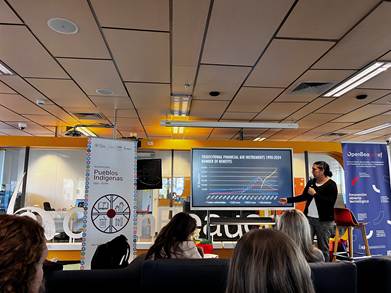
Our very own CSHPE alumna Dr. Paula Clasing gave an enlightening and through overview of the history and context surrounding the Free Tuition policy.
Dr. Clasing provided us context on Chile’s higher education system. For example, regarding 2025 enrollment in higher education, about 44% of students are enrolled in Career and Technical Education programs and roughly 56% are in the university system. Within the university system, roughly 30% attend institutions that comprise the traditional university system, known as CRUCh. These higher education institutions typically have greater prestige, longer trajectories and consequently also exert greater influence in higher education policy. Importantly, Chile went through significant massification in higher education during the 1990s and early 2000s.
Overview of Chile’s Student Financial Aid System: In 1981 tuition and fees are introduced (public higher education is no longer free). In 1990, scholarships and the FSCU loan were introduced for traditional universities, and subsequently in 2006 the CAE loan became available for any accredited higher education institution. This was a state-backed merit-based loan. However, as it only covered a proportion of the student’s true tuition cost, students were left paying 20-50% of their studies. Furthermore, the application process was complicated- criteria varied and students needed to re-apply every year. Given the rising costs and student debt, coupled with a lack of opportunities, students erupted in protest in 2011, demanding free and quality education. Michelle Bacehelet assumed presidency in 2014 and this issue formed part of her agenda. Then, in 2016, the gratuidad (free tuition) policy was enacted and included in the Ministry of Education’s budget of 2016.
There was significant debate surrounding which institutions and who should qualify for the free tuition policy. Understandably, the University sector thought it should only be offered to traditional institutions and go directly to the higher education institution as a subsidy. The political right and the private universities disagreed but thought if the free tuition policy was going to move forward, then it should first be applied to the CTE sector.
Numerous debates and conversations ensued, regarding how exactly this policy could be implemented. Ultimately, it was determined the way to do this is to regulate tuition prices and only the tuition value determined by the Chilean government will be covered. Given funding limits, there was also a need to regulate enrollment capacity, otherwise there would not be enough funds to cover all of the potentially eligible students.
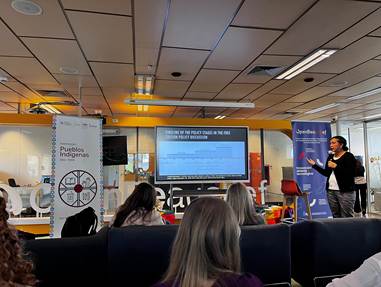
Thus, in accordance with the enacted policy, to qualify, students need to fill out the FUAS (simpler than FAFSA). Based on a family’s income, students are classified along deciles and students who belong to the poorest six deciles receive free tuition. They do not have a copay. This free tuition policy only applies, however, at higher education institutions with an accreditation level of at least four years. Lastly, 61% of public expenditure in higher education is assigned to the Free Tuition policy.
Significance of the gratuidad policy: This represented a radical change in the Chilean student financial aid system, and for society, it helped shift the notion of education as a private good to a social right or public good.
by Jennifer Trigger