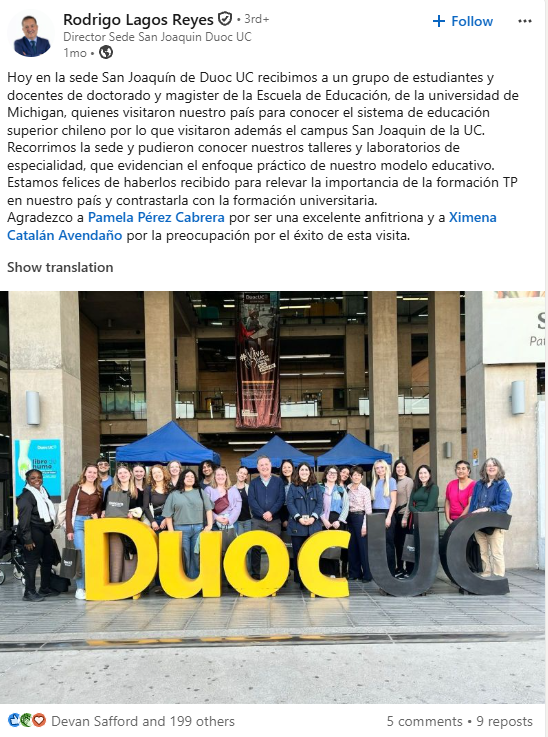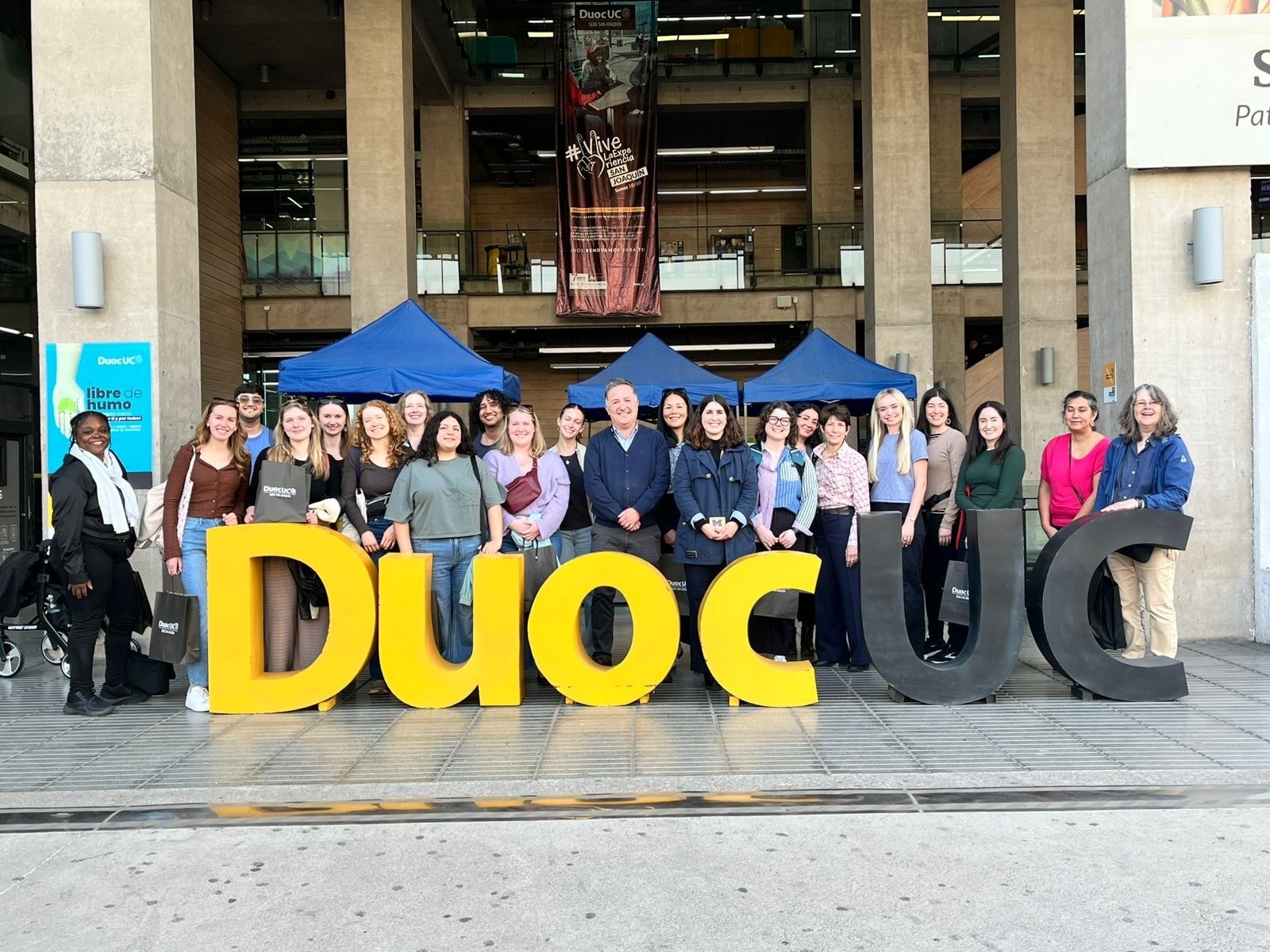
Following our morning visit and lunch at Pontifica Universidad Católica de Chile, we walked across the street to visit Duoc UC’s San Joaquín campus. Duoc UC was founded in 1968 as an initiative of students and faculty from Potifica Universidad Católica de Chile. It is a private, Catholic, non-profit institution dedicated to technical and professional education. Today, the institution boasts nine schools with 96 technical and professional degree programs across 17 campuses in Santiago, Valparaíso, Biobío, La Araucanía, and Los Lagos. It is one of the top providers of technical and professional education in Chile, serving around 80,000 students nationwide. At Duoc UC, technical programs generally last 2.5 years while professional programs last four years.
The San Joaquín campus in Santiago houses programs under three of the nine schools: the School of Computer Science and Telecommunications, the School of Engineering and Natural Resources, and the School of Health and Wellness. Pamela Pérez, the Associate Director of Admissions, Communications, and Outreach, was our guide for the afternoon. Rodrigo Lagos, the Director of the San Joaquín campus, also joined us. On our tour, we visited the facilities for automotive mechanics, electrical engineering, dentistry, nursing, pharmacy, and programming.
Duoc UC’s programs are designed to be hands-on and focus on developing workforce-related skills. Therefore, Duoc UC’s teaching facilities mimic real-world work environments including hospitals, dentist offices, and auto repair shops. Additionally, the institution aims for all of its instructors to be connected with industry so that students are learning from people who work in the field. In Duoc UC’s automotive mechanics program, classroom instruction and hands-on instruction share equal time.

Besides instructional spaces, the San Joaquín campus offers spaces for students to study, eat, and socialize. Due to its urban location, the San Joaquín campus is a single large building. There are multiple cafes throughout the building, creating spaces for students to eat and congregate during the day. There is also a large terrace providing students with an outdoor space, compensating for the fact that there is limited outdoor space surrounding the building. This terrace is where we ended our tour, and it is probably the most striking feature of the campus due to its size and the fantastic view of the city and mountains.
Duoc UC is an open-access institution, meaning that students only need to graduate high school to gain admission to any of its programs (though a few programs have special requirements). Because of its open-access mission, Duoc UC faculty and staff notice that students often arrive with gaps in their foundational knowledge in areas such as math and language. To help improve students’ preparation, they created a program called Semester Zero, a series of free online courses that students can take before arriving on campus to improve their foundational knowledge. While the program is optional, students are incentivized to participate because they can earn credit for the courses they pass in Semester Zero.
When touring Duoc UC, I identified a lot of similarities between the San Joaquín campus and community college campuses I have toured in the United States. As an example, the photos below show the similarity of instructional spaces for pharmacy technician programs at Duoc UC (left) and Forsyth Technical Community College in Winston-Salem, NC (right).

Many of Duoc UC’s programs, like the automotive technician, electrician, and pharmacy technician programs, are programs we would traditionally expect to see offered by community colleges in the United States. While it is easy to draw comparisons between Duoc UC and U.S. community colleges, they are distinct for a number of reasons. There is no equivalent to the U.S. community college system in Chile. Duoc UC, like nearly all of the technical and professional institutions in Chile, is private. Public institutions in Chile do not typically offer programs geared towards career and technical education. Additionally, while Duoc UC and Pontifica Universidad Católica de Chile (UC) do maintain partnerships and collaborations, there is no option or expectation for students to transfer from Duoc UC and eventually earn a traditional baccalaureate degree.
by Isabelle Cosby