Bouncing Back from COVID: STEM Students' Post-Pandemic Resilience and Flourishing
Contributing Researchers
Minso Choi, M.A., The Ohio State University
Department of Educational Studies
Please contact for further information at [email protected]
Yumiao Hui, M.A., University of Virginia
Department of Statistics
Dr. Angela Ebreo, University of Michigan
Center for the Study of Higher and Post-Secondary Education
After COVID-19, students are expected to return to normal pre-pandemic routines, even as many continually battle anxiety, depression, fear of illness, and pandemic fatigue (Kupcova et al., 2023). However, since the pandemic, “resilience” (e.g., an individual’s ability to bounce back from adversity or challenges; Martin & Marsh, 2003) and “flourishing” (e.g., positive well-being, feeling like life has purpose; Yıldırım & Green 2023) have become the defining terms of our collective experience. Our study examined STEM students’ resilience and flourishing, ongoing COVID-related stress and fatigue, and financial stability as an uncontrollable outside factor (e.g., student loan aid, scholarships, internships/jobs, and others).
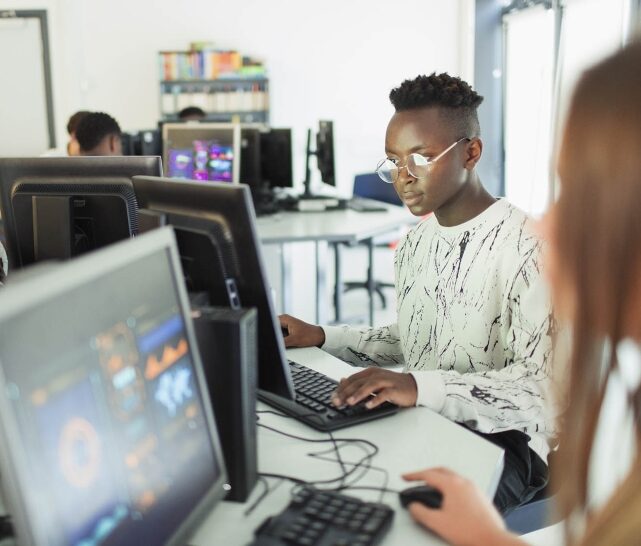
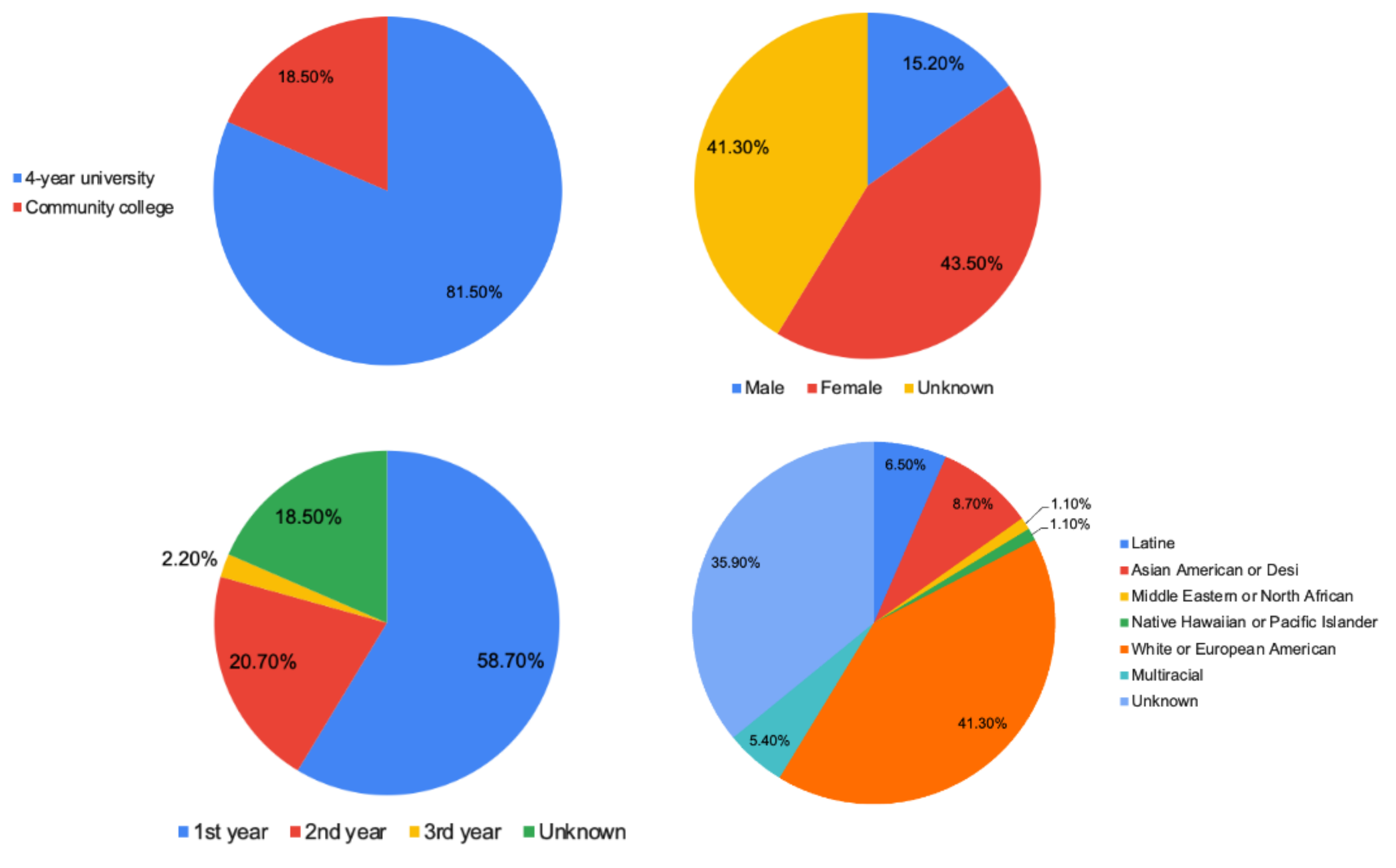
We examined 92 undergraduate STEM students during the 2022-2023 academic year (43.5% were female, 81.5% attended 4-year public universities, and 18.5% attended community college; see figure 1). There were 4 main findings:
- Students still experienced COVID-related stress and fatigue in 2022-2023
- COVID-related fatigue boosted resilience and flourishing, while stress had no effect
- Better financial stability improved students’ resilience and flourishing
- Better financial stability increased COVID stress and fatigue, suggesting students may be facing other life stressors
Our findings reveal that STEM students are developing resilience and flourishing but are still experiencing lingering COVID-related stress and fatigue. Universities must support this transition back to normalcy. Although further research is needed to understand best methods for supporting students, current research recommends helping students navigate the “hidden curriculum” in higher education, addressing educational challenges, and using trauma-informed approaches (for example, the “Four R’s”: realization, recognition, responding, and resisting retraumatization) (Minkos & Gelbar, 2021; Pownall et al., 2022).
Figure 1
Study Demographics
Acknowledgement
This work was partially supported by a grant from the Directorate for STEM Education, National Science Foundation 2109942, Tabbye Chavous, PI). The opinions, findings, conclusions and recommendations expressed are those of the authors and do not reflect the views of the National Science Foundation.
References
Kupcova, I., Danisovic, L., Klein, M., & Harsanyi, S. (2023). Effects of the COVID-19 pandemic on mental health, anxiety, and depression. BMC psychology, 11(1), 108. https://doi.org/10.1186/s40359-023-01130-5
Martin, A. J. & Marsh, H. W. (2003). Academic Resilience and the Four Cs: Confidence, Control, Composure, and Commitment.
Minkos, M. L., & Gelbar, N. W. (2021). Considerations for educators in supporting student learning in the midst of COVID‐19. Psychology in the Schools, 58(2), 416-426. https://doi.org/10.1002/pits.22454
Pownall, M., Harris, R., & Blundell-Birtill, P. (2022). Supporting students during the transition to university in COVID-19: Five key considerations and recommendations for educators. Psychology Learning & Teaching, 21(1), 3-18. https://doi.org/10.1177/1475725721103248
Yıldırım, M., & Green, Z. A. (2024). Social support and resilience mediate the relationship of stress with satisfaction with life and flourishing of youth. British Journal of Guidance & Counselling, 52(4), 685-696. https://doi.org/10.1080/03069885.2023.2172551